

Hi, I'm Erika Gilchrist!
Instructional Designer | Trainer & Facilitator | Neuroscience Coach
I create learning experiences that make complex ideas easier to understand, harder to forget, and a lot less painful to sit through. My work blends neuroscience, curriculum design, and a speaker’s instinct for keeping people awake, engaged, and ready to apply what they’ve learned. Take a look below to see how I turn information into instruction that actually works. All curriculum is designed for adult learners and is customizable to suit the needs of your organization.
More Than a Course
My instructional design work can be licensed as a standalone learning experience or expanded into a full training ecosystem. Depending on the needs of the organization, customized curriculum may include a self-paced eLearning module, facilitator’s guide, participant workbook, discussion prompts, scenario-based activities, knowledge checks, manager tools, and branded learning assets.
For organizations that want deeper implementation, I also offer live activation sessions, train-the-trainer support, rollout guidance, and post-training debriefs. This allows teams to not only complete the course, but discuss it, apply it, reinforce it, and connect the learning directly to real workplace behavior.
Highly engaged teams show 23% higher profitability, 18% higher sales productivity, 14% higher production productivity, 78% lower absenteeism, and 21% to 51% lower turnover.
*Gallup’s Q12 meta-analysis
Work Without Wreckage
A Smarter Approach to Burnout, Capacity, and Shared Responsibility
Click below for the content lesson
Click below for the interactive portion


The Problem
Burnout is often misunderstood, mislabeled, or dismissed as laziness, weakness, or a bad attitude. In the workplace, that misunderstanding can lead to poor conversations, missed warning signs, and ineffective solutions. Employees may know they’re exhausted, but they may not know whether they’re dealing with normal stress, early burnout, or something else entirely.
The Solution
I created Work Without Wreckage, an interactive eLearning experience that helps learners recognize the difference between stress, burnout, and common workplace misinterpretations. Through short animated scenes, visual examples, and decision-based interactions, learners practice identifying what a worker may actually be experiencing before jumping to conclusions.
Style and Interface
The design uses a clean, animated visual style with bold colors, character-based scenarios, and simple on-screen choices to keep the learning approachable and easy to navigate. The interface allows learners to make quick decisions, compare options, and engage with the content instead of passively watching information move across the screen. Humor, relatable workplace moments, and clear visual contrast help make a serious topic feel less clinical while still keeping the message grounded and professional.
Versatility
This piece can function as a self-paced eLearning module, a microlearning activity, a discussion starter for live training, or a supplemental tool inside a larger burnout prevention program. Because the content is scenario-driven, it can be adapted for employees, managers, or leadership teams and expanded into deeper modules on workload, boundaries, communication, and organizational responsibility.
The Process
I followed the ADDIE model (Analyze, Design, Develop, Implement, and Evaluate) to bring this project to life. I mapped key actions during the analysis phase, built a text-based storyboard in the design phase, and created visual mockups and an interactive prototype during development. Each step kept the solution focused on the learners’ needs and made the experience engaging and realistic.
The Problem
In corporate environments, professionals are expected to communicate clearly in meetings, presentations, Zoom calls, sales conversations, client updates, and leadership discussions, often with very little formal training. As a result, strong ideas can get buried under nervous delivery, unclear messaging, rambling explanations, weak structure, or low audience engagement. When communication breaks down, people do not just lose attention. They lose influence, confidence, buy-in, and opportunities.
The Solution
I created Savage Speaker Lab as a communication and presentation skills course that helps learners organize their thoughts, strengthen their delivery, and speak with more clarity, confidence, and intention. The course uses storytelling, instructor-led video, animated teaching segments, practical examples, and follow-up resources to help learners improve how they show up in real workplace communication moments. Instead of focusing only on public speaking, the experience teaches transferable skills learners can apply immediately in meetings, virtual calls, sales conversations, team briefings, and professional presentations.
Style and Interface
The course blends live instructor presence with bold animated visuals, dynamic screen displays, character-based examples, and clean instructional graphics. Having me on screen adds energy, warmth, and credibility while keeping the learning experience from feeling flat or overly scripted. The pacing moves between direct teaching, storytelling, visual explanation, and practical reflection, creating a course that feels polished, personal, and easy to follow without boring the learner into silent resignation.
Versatility
This piece can function as a self-paced online course, a blended learning resource, a cohort-based training tool, or a supplemental module inside a larger leadership, sales, communication, or professional development program. The content can be adapted for employees, managers, sales teams, emerging leaders, entrepreneurs, and subject matter experts who need to communicate with more authority and clarity. Supported by handouts, templates, and real-world resources, the course gives learners tools they can use immediately in the conversations and presentations that shape their professional success.
Savage Speaker Lab: A Scenario-Based Speaker Development Training
An interactive learning experience designed to help novice speakers build confidence, clarify their message, improve professional communication, and understand the business of influential talks.


Speak Up Without Spinning Out
A neuroscience-based lesson on finding your voice when the pressure is high and the stakes feel personal.


The Problem
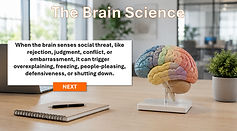
Many professionals struggle to speak up in tense workplace moments without overexplaining, freezing, people-pleasing, sounding defensive, or shutting down completely. Even when they know something needs to be said, social threat can make the brain react as if the conversation is unsafe, which often leads to responses that damage clarity, confidence, or credibility.
The Solution
I created Speak Up Without Spinning Out, a simple scenario-based learning experience that teaches learners how to respond to difficult workplace communication moments with more control and intention. The lesson introduces the brain science behind social threat, then gives learners a realistic scenario where they can practice thinking through a response before applying it in real life.
Style and Interface
The design uses clean visuals, realistic workplace imagery, minimal text, and a straightforward click-through interface to keep the learner focused. Each screen is intentionally simple, with one clear idea or scenario at a time, so learners can absorb the concept without cognitive overload. The tone is practical and grounded, making the lesson approachable for professionals who need useful communication tools without a long, complicated course.
Versatility
This piece can stand alone as a short microlearning lesson or be used as part of a larger communication, leadership, emotional intelligence, or workplace conflict training program. Because the content is focused and easy to adapt, it can work well for employees, managers, new leaders, or teams that need a simple framework for speaking up with more clarity and less reactivity.
The Process
I followed the ADDIE model (Analyze, Design, Develop, Implement, and Evaluate) to bring this project to life. I mapped key actions during the analysis phase, built a text-based storyboard in the design phase, and created visual mockups and an interactive prototype during development. Each step kept the solution focused on the learners’ needs and made the experience engaging and realistic.
Testimonials


Ready to book a call? Help me understand your goals, timeline, audience, and level of support needed so our call can be focused, productive, and worth your time. Click below to book a call with us.
FAQs
1. Do you offer live training in addition to the course?
Yes. The course can be paired with live activation sessions delivered virtually or in person.
These sessions are designed to bring the curriculum off the screen and into real conversation, helping leaders, managers, and employees apply the concepts to the actual challenges they’re facing inside the organization. Live sessions can be used to reinforce key lessons, facilitate discussion, address questions, and create stronger buy-in across teams.
2. Is there a sample lesson you can show us?
Yes. You can view brief samples above. The samples are designed to give you a feel for the tone, structure, pacing, and practical application of the curriculum. It won’t show every layer of the full experience, but it will give you a strong sense of how the content is taught and how learners are guided to connect the material to real workplace behavior.
3. What topics do you offer?
Topics may include:
-
Organizational burnout reduction
-
Leadership development
-
Psychological safety and belonging
-
Women’s leadership
-
Conflict management & communication
-
Workplace presentation & speaking confidence
-
Neuroscience of behavior change
The goal isn’t to force your organization into a pre-built topic box. The goal is to build learning that actually serves the people inside your organization and supports the outcomes you’re trying to create.
4. I need a training right away. Is there something we can implement immediately?
For organizations that want to move quickly, we offer a rapid-start live pilot that allows your team to experience the core content, interaction, and Burnout Intelligence Layer before moving into a full course rollout.
A ready-to-license version can be available for organizations that need deployment relatively quickly. That said, I only recommend this option when speed matters more than customization. The immediate-license version is a broad, foundational curriculum, which means it isn’t tailored to your specific culture, employee challenges, leadership structure, internal language, or organizational goals.
For the strongest impact, I recommend a customized version that aligns with what your people are actually experiencing and what your organization is trying to shift. But when timing is urgent, the ready-to-license option can provide a strong starting point while still giving your team practical language, concepts, and tools right away.
5. Which format(s) do you use when delivering the product?
The curriculum can be delivered in several formats depending on your organization’s needs.
Options may include:
-
LMS-ready online learning (SCORM)
-
Self-paced course modules
-
Virtual live training
-
In-person training
-
Blended learning, combining online coursework with live activation sessions
-
Manager-specific learning tracks
-
Employee-facing learning tracks
-
Licensed internal training materials